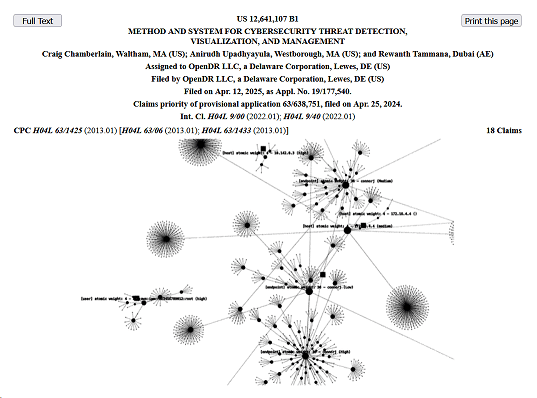
Detection Lattices For Emerging Threats: “Dirty Frag”

Today’s scenario is probably what the future looks like. A new Linux exploit, named “Dirty Frag”, was released yesterday after the embargo elapsed. No patch or broadly available detections yet exist; guidance from security vendors, at the time of this writing, is that they are “working on related detections.” We don’t have to wait for humans to write detection rules; we can find this using detection lattices without waiting for static rules to be written.

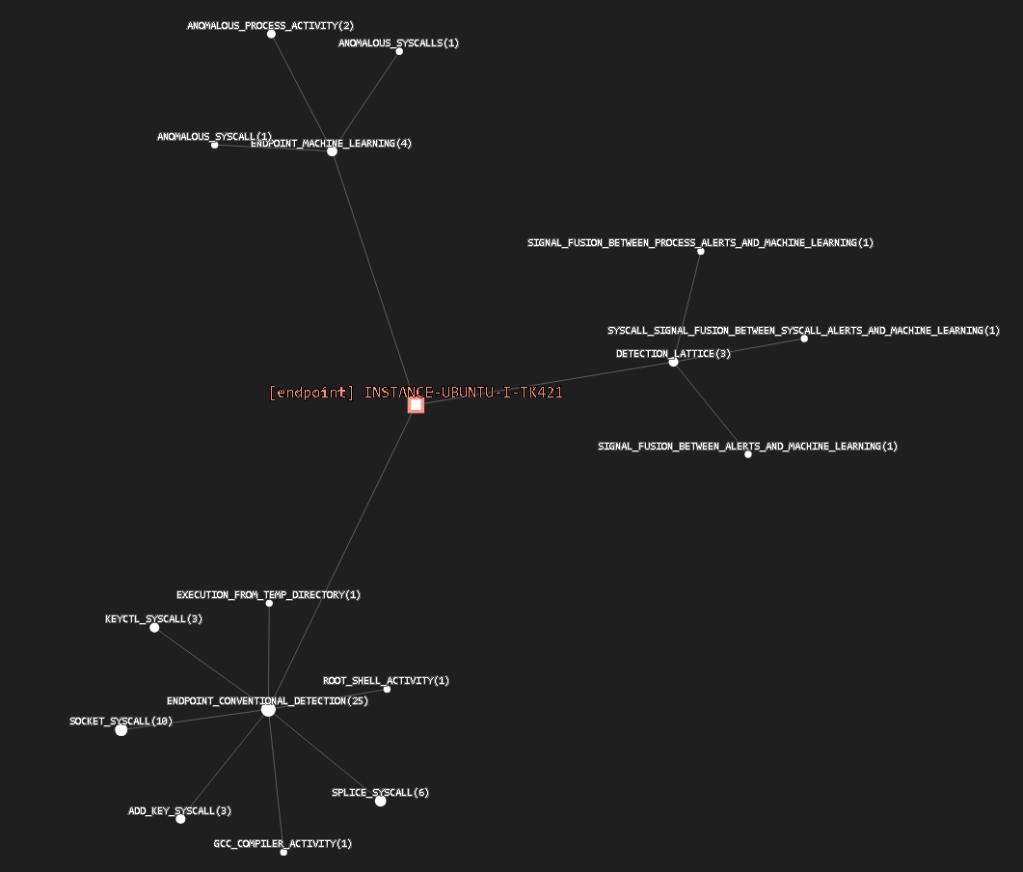
The Dirty Frag PoC lights up a detection lattice like a Christmas tree with at least three conventional behavioral detections, four machine learning detections, 21 unusual syscalls, and three signal fusions between these detection classes as shown below:

While none of these, by themselves, are sufficient to produce a critical alert, the combined set creates a strong alpha signal detection lattice. This lattice tells us that anomalous compiler activity, followed by anomalous process activity from the temp directory, was followed by a cluster of syscalls, and ultimately a root shell. Each of these alerts do sometimes come from benign outlier activity, but the confluence is too unusual to be coincidence.

There is one school of thought that this class of exploit is low or medium risk because it is not remotely exploitable without existing shell access. I think this kind of assumption works against us, and is one of the ways vuln management misses attack paths and things get popped. If an attacker is going to obtain a root shell through an exploit like this, they’re most likely going to get initial execution by looking for an RCE or RCI vuln in a web application (often a target rich environment) not a CVE in the web server process . Maybe something that has a CVE, maybe something bespoke in the application code that the owners have not noticed, or have given low priority because it yields low privilege execution. In order to see these kinds of attack paths, you need a fusion of CVE and appsec data. Explore your combined attack surface and ask two questions 1) What can I get right now? 2) What path can I take to get something valuable?

Also, I think the conventional “scan, attack, exploit, actions” model is not necessarily how operators work. It is not always feasible to achieve actions on objectives in linear time on a target of choice if the conditions are not quite right. So some crews are “collectors” in that they collect as much persistence as they can, in as many networks and cloud accounts as they can, so that when a privesc becomes available, they can jump on it and be the first. Sometimes we do see a conventional discovery, execution, initial access, persistence, privesc, lateral movement cycle in a short windows of time, but sometimes it comes from a crew or an operator who have been persisting in the environment for a while. So sometimes people are looking for discovery or initial access that happened a long time ago and think everything is fine because they are not detecting the start of a cycle.

Although I suppose model based vuln development changes all this in that the time frame will probably be compressed, and there are rapid cycles to find. The question I see is what happens if the cycles become faster than human response or even human cognition. We’re scaling up offensive (attack) art first, with AI, because the models are good at that, and nothing attracts eyeballs and sells things like dramatic attack case studies. We’re not really scaling up agentic defense yet.

This scenario – a new exploit without a patch or available detection rules – is probably going to more more and more common as AI-assisted vulnerability and exploit development continues to scale. As the volume and velocity increases, we will not always have time for humans to manually write detections. We will increasingly need robust detection lattices capable of identifying emerging threats without de novo signatures, exploit-specific rules, or even prior threat intelligence

Hunting the Copy Fail Exploit With Detection Lattices

So the Copy Fail exploit (https://copy.fail/) is the hunt of the week. If you’re one of the few who have not heard, it is a Linux privilege escalation vuln, with a working exploit, that advertises elevation to root on any Linux distro from the last nine years which would include most fleets. I can’t confirm that but I can confirm it works very reliably on the Ubuntu instances I have seen it on. I know there is one school of thought that local privesc exploits are of lesser importance because they require starting from an existing shell. Many of the flags I have seen taken were the result of combining low-privilege remote code execution, or command injection, with local privilege escalations. These threat models are usually not visible from either a vulnerability management tool, or an appsec tool, because neither of those usually show users this kind of attack path, because neither one knows much about the other. So this one is worth hunting or at least threat modeling; the odds are this attack path exists somewhere in your environment.

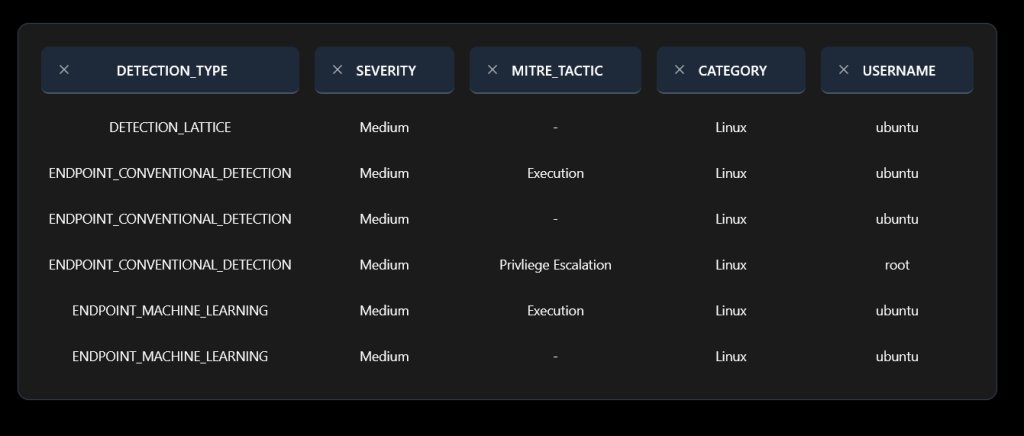
This is an excellent case study for the PROTOSTAR project because, as we are seeing, there isn’t really a good conventional alert rule that can be written for this, there are simply too many moving parts and shades of grey. None of the events involved are clearly and distinctly bad enough to fire an important alert. It does, however, produce an alpha detection signal set. Here is what it looks like in what we call the tactical view which uses a table structure for packaging lattices as questions sent to an AI agent along with the appropriate prompts and knowledge:

The exploit creates what we call an alpha signal with a perfectly matched set of conventional and machine learning detections. As you can see, there are three types of regular alerts, for execution and privilege escalation, and two machine learning detections. These cannot be joined by a single process ID or username because there are at least two of each involved. What’s more important than any of those conventional joins or correlations is the fact that the conventional and machine learning detections fired on the same events. The “detection lattice” element was created when the PROTOSTAR engine noticed that pattern.

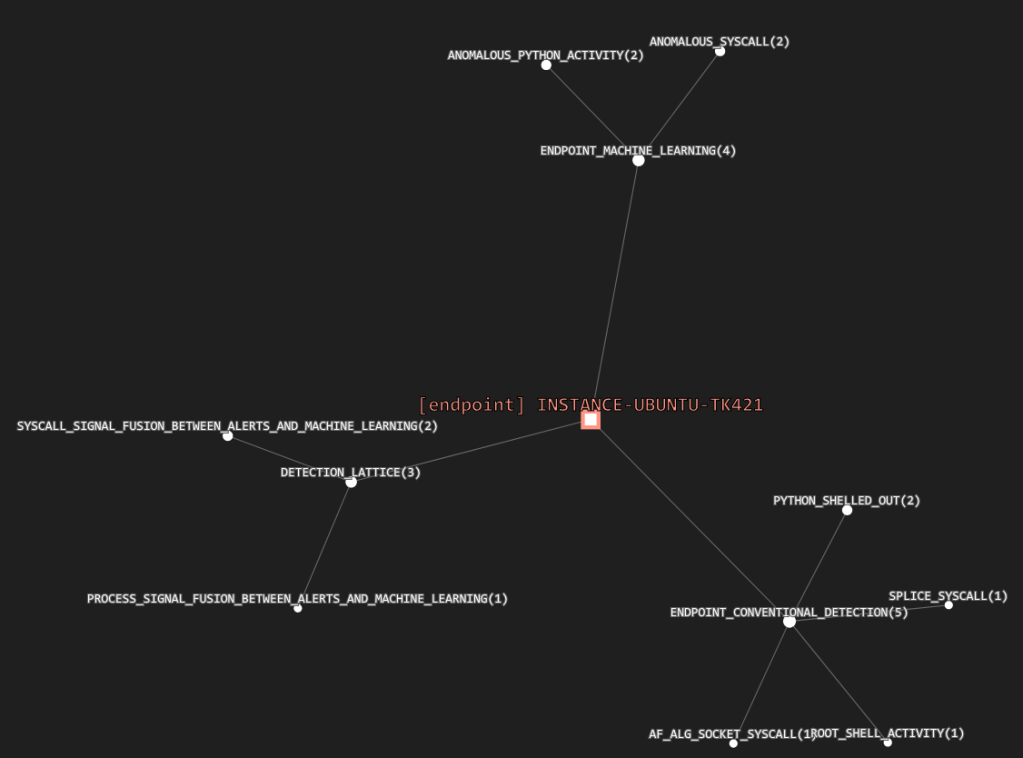
This is what a Copy Fail detection element set looks like in what we call the visual view:

This is the detail page, in the visual view, for a Copy Fail detection element. The trinary node structure is created by the relationships between the detection elements in the set. In the northern quadrant, there are two different machine learning detections for the Python activity and some of the syscalls used by this exploit payload – both are unusual, but as most of us know, many ML anomaly detections don’t have stronger signal than the conventional alerts they try to replace. There are simply too many normal outliers. These Python events, and the associated syscalls, are unusual, but Python scripts and syscalls are not inherently suspicious enough to turn them into alerts by themselves. In the southeast quadrant there are three types of conventional rule based detections for the Python shell activity and the associated syscalls. These again are not clearly malicious, when considered individually. None of these, so far, are decidable enough to fire alerts on individually.

What we call a detection lattice is in the southwest quadrant. What this indicates is that the engine saw multiple agreements, on the very same events, by the different detection pipelines. The conventional alerts tell us these events could be threat activity, possibly even something like Copy Fail. The machine learning detections tell us that these events are extremely unusual for this compute instance. One detection lattice is enough to create what we call a beta signal – essentially meaning suspicious activity is happening that is far outside what normal looks like. Multiple detection lattices is enough to create what we call an alpha signal. An alpha signal is usually a true positive detection because this many strange things, that resemble potential threat activity, happening in the same place, at the same time, by pure chance, is simply improbable.

The syscall events and associated detections here are something new we just added to our endpoint project. We’re going to start logging more types of syscalls using something like bpftrace (very carefully, as we generally don’t want to log every single syscall, particularly the one that are already evented.) The process detection elements, both conventional and machine learning, can be created today without eventing the syscalls used by Copy Fail.

Show and tell: agent smith


So we are seeing more and more cases of malicious code injected into shared models, skills, tool, agents, and projects. I had a case where a shared model had a number of malicious code blocks that the users had not noticed due to the size of the codebase. At the time of this writing, we are seeing proliferation of malicious skills and prompts with a variety of payloads. When run in an IDE with AI tools, much of these produce execution and C2 activity that is detectable if something was watching closely enough. The challenge is that these events will be in a haystack of benign process and network events from tasks the AI tools were given permission for by the user. One of the purposes of the ODR (open DR) project is to hunt for this class of threat activity using anomaly detection techniques and a learning informed detection pipeline that is continuously updated.

One reason to run these hunts at the local level, in addition to conventional SOC and SIEM operations, is that the definition of what normal looks like, for a particular IDE, is largely in the head of the developer. Another reason is that much of the context is on the endpoint where the activity took place, and all of that state cannot generally be logged to a SIEM due to data volume and cost. At the same time, devs cannot monitor every action taken by their tools, and they are not trained in what to look for. This feels like a job for an autonomous agent pack.

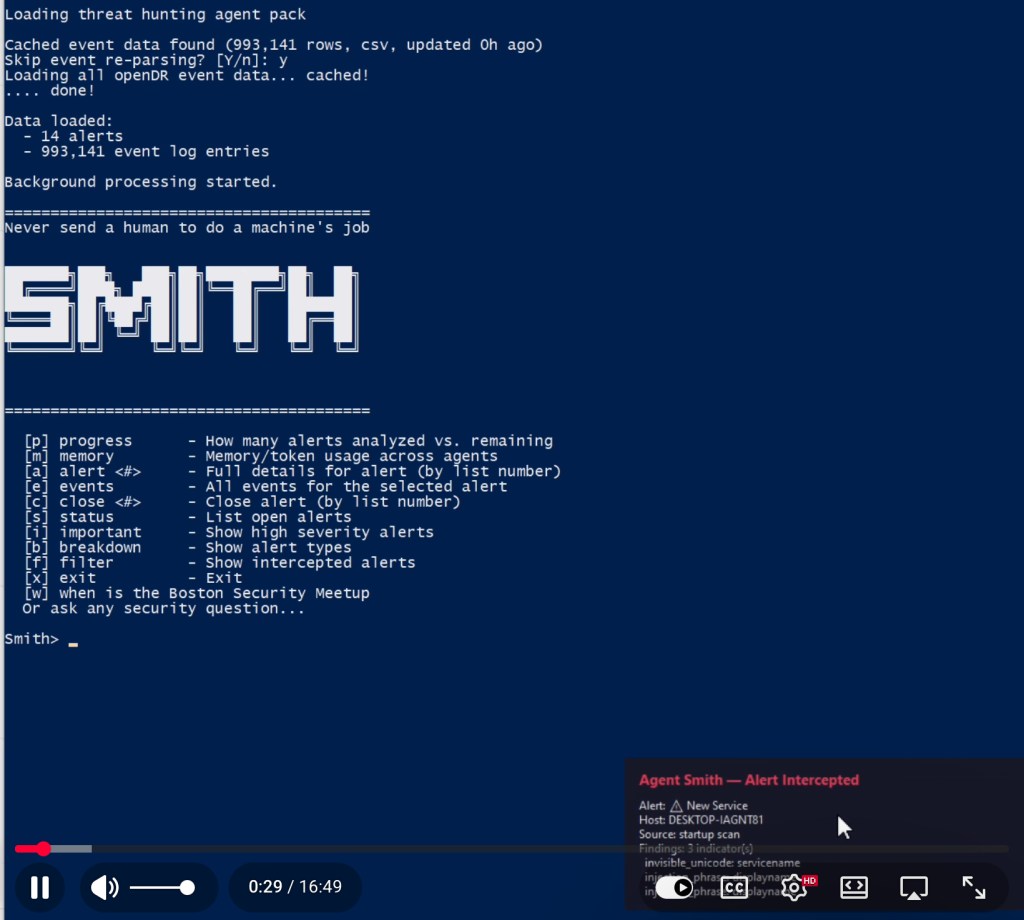
Smith is an autonomous agent pack that will process most alerts and anomaly detections generated by ODR (open DR, also in this GitHub org.) ODR mainly looks for strange things happening in your AI dev tools at present but Smith will process most alerts generated by ODR. There is a show and tell video here: https://youtu.be/lsh3JRne9sg and the project lives in a repo here: https://github.com/opendr-io/agentic-park/tree/main/smith

Smith processes raw event and alert data from the ODR (open DR) project in order to investigate alerts and anomaly detections. It outputs an analysis of each alert. It lets you know when it thinks it has a high confidence detection and engages you in a collaborative analysis conversation in order to work out whether the detected activity is benign and expected or unexpected and potentially malicious.

Some sample alert data is provided so that it can do something out of the box. Sample event data is not provided due to its size, and the need to sanitize it, but can be generated by running openDR. It has a filter layer to try to stop prompt injections from reaching the agents and one filter test case alert is included in the sample data; you will see it get “intercepted” by the filter. That is an interesting area of research and we would like to hear from both offensive and defensive researchers as we add more filtering techniques and more detections.

The Causality project

Some time ago, one of my stakeholders said, “We may never get to zero cves. How can we identify the ones that matter the most?” Annual CVE volume has since quadrupled over the past decade. Recent research continues to explore the challenges associated with vulnerability management, and the limitations of existing prioritization methodologies, such as severity, which are not always good predictors of exploitation and risk. [1] [2] EPSS, while more sophisticated and predictive, is an ongoing topic of discussion as to whether it predicts exploitability or exploitation. [3] Of the roughly forty thousand CVEs issued last year, less than a percent were added to watchlists for observed exploitation activity and we lack a methodology for targeting this subset. Having spent a good deal of time with red teams, I believe exploit selection and usage resembles tool or equipment selection in other adversarial pursuits. I would liken it to athletes choosing equipment, lawyers choosing precedents and arguments, or warfighters choosing weapons and tactics. Factors such as theaters of operations, playing fields, opponents, past experience, and bias for successful tactics used in the past, are more influential to selection than mathematical scores and metrics used by existing prioritization methodologies. 

Last year, I experimented with applying a number of machine learning models to the problem of CVE prediction and arrived at one that yielded the best results which we named CAUSALITY. This model has, at the time of this writing, produced sixty provable correct predictions. A provable prediction means that a CVE was rated “hot” or “warm” – meaning it has potential to see heavy exploitation and be watchlisted – before it was added to a watch list. The prediction lead times range between days and months. The predictions are published in a Github repo (https://github.com/opendr-io/causality) where anyone can audit them to verify we are making predictions forward in time by comparing the time deltas. The correct predictions made to date are summarized in the readme for the repo where the raw data is published. I am not publishing output there constantly, only enough to prove prognostication, as extraordinary claims require extraordinary evidence.

On the questions of sensitivity, specificity, precision and recall; I am open to suggestion. Is a prediction a false positive if it does not come true in a month? In three months? a year? The interval for the published predictions ranges from a few days to as long as 137 days. Meanwhile, the watchlists continue to upgrade CVEs from prior years, even some from the prior decade, as they are selected for weaponization by threat actors. The way I think about this is more like having an advantage in an adversarial process. If this were hockey, instead of cybersecurity, and a model could predict that most successful shots on goal would come from a subset of 8-11% of the total shots, that would increase our odds of winning the game. Prioritizing a subset of CVEs according to their potential yields a larger risk reduction at a lower cost relative to existing processes.  When exploitation cycle avoidance can be realized, where the prediction lead time is sufficient, the ROI is much higher.

CVEs have interesting differences from other data domains. CVE classification differs from malware classification in that there are no benign CVEs apart perhaps from those that have been rejected or withdrawn. They are on a gradient of risk potential, and some never amount to much of anything, but their presence cannot be considered benign. Rather, the objective is to try to identify the smallest set that yields the greatest risk reduction, and to deal with those quickly enough to avoid exploitation.

[1] https://arxiv.org/abs/2302.14172: Enhancing Vulnerability Prioritization: Data-Driven Exploit Predictions with Community-Driven Insights

[2] https://arxiv.org/pdf/2508.13644v1: Conflicting Scores, Confusing Signals: An Empirical Study of Vulnerability Scoring Systems

[3] https://www.linkedin.com/posts/resilientcyber_vulnerability-scoring-frameworks-activity-7363978158439600128-oS3t?utm_source=share&utm_medium=member_desktop&rcm=ACoAAAAZIaEBGLaE7H8r2VCTwQayr6Vq_PFIqYY,